
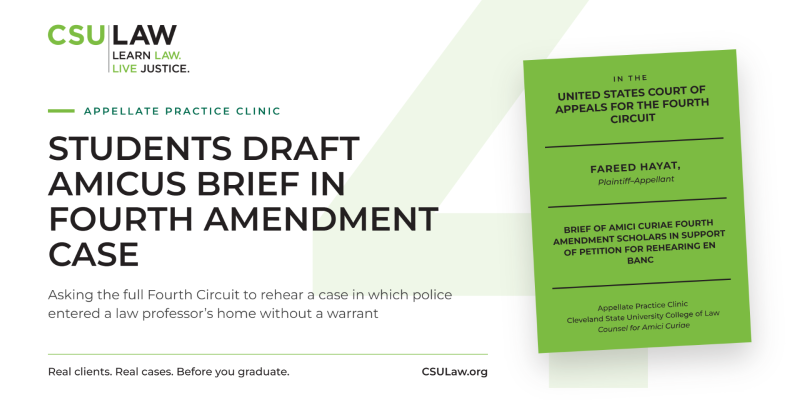
CSU Law Students Draft Amicus Brief in Fourth Amendment Case
Most law students meet the Fourth Amendment in casebooks. This fall, four students in CSU Law’s Appellate Practice Clinic wrote an amicus brief asking the full U.S. Court of Appeals for the Fourth Circuit to rehear a case in which police forced their way into a law professor’s home without a warrant.
Fareed Hayat, then teaching at Howard University School of Law and now at Seton Hall Law, had just eaten at a Maryland pancake restaurant and buckled his three young children into the rear-facing seats in the trunk of his Tesla. A witness thought he was kidnapping them and called the police. Montgomery County officers traced the car to his home in Silver Spring and questioned him on the porch. Hayat denied any wrongdoing and went inside. The officers then pushed through the door without a warrant, threw him to the floor, and handcuffed him in front of his wife and children, leaving once they realized their mistake. Hayat sued and lost in the district court. In August, a Fourth Circuit panel affirmed. It held that a Terry stop the officers began on the porch could be finished inside the house, and that exigent circumstances justified the entry.
Georgetown Law’s Civil Rights Clinic, which represents Hayat, petitioned for rehearing en banc. To support the petition, it asked CSU Law’s clinic to write an amicus brief on behalf of several nationally recognized Fourth Amendment scholars, among them CSU Law’s own Professor Jonathan Witmer-Rich.
CSU Law students Faith Croskey, Renata Kosc-Harmatiy, Matthew Mayberry, and Rachel Revehl were eager to help. Under the expert supervision of Professor Doron Kalir, who directs the clinic and served as counsel of record, these students worked nights and weekends, paying particular attention to the limits of the Terry stop. That doctrine started a few blocks from the law school. In 1963, Cleveland detective Martin McFadden stopped and patted down John Terry on Euclid Avenue, and the Supreme Court upheld the frisk in Terry v. Ohio five years later.
“My takeaway is that the heart of appellate advocacy isn’t fiery speeches or flowery words. It isn’t even being right. It’s painstaking research with the power to carry the argument and give the court a real reason to reconsider.” — Rachel Revehl, JD Candidate 2028
“This experience has affirmed that the power of a committed legal team to support each other is crucial to supporting a client, and that result is a more profound motivator to work relentlessly than any letter grade.” — Renata Kosc-Harmatiy, JD Candidate 2027
In the Appellate Practice Clinic, students perfect appeals, write the briefs, and argue the cases, often for prisoners, people experiencing homelessness, immigrants, and LGBTQ clients. Most of its work is in Ohio’s Eighth District Court of Appeals, the Supreme Court of Ohio, the Board of Immigration Appeals, the Sixth Circuit, and the U.S. Supreme Court. Hayat is its first case in the Fourth Circuit.
“At the end of the day, it is all about the students. Writing an Amicus Brief for a Federal Court of Appeals on such short notice is a monumental assignment; without the students’ enthusiasm, energy, and dedication, it would have simply been impossible. I’m truly happy with our work product, and I’m even happier to see our students stand proud on the national stage, alongside the best Clinics in the nation.” — Professor Doron Kalir, Senior Clinical Professor of Law and Director, Appellate Practice Clinic
Real clients. Real cases. Before you graduate.
That's the promise of experiential learning at CSU Law, and this Amicus brief is a case in point. These students didn't just study how the Fourth Amendment protects people in their homes in theory; they actually helped make the argument to a federal Court of Appeals that can decide what that protection means.
Learn more about the Appellate Practice Clinic and CSU Law's other clinics at CSULaw.org.