
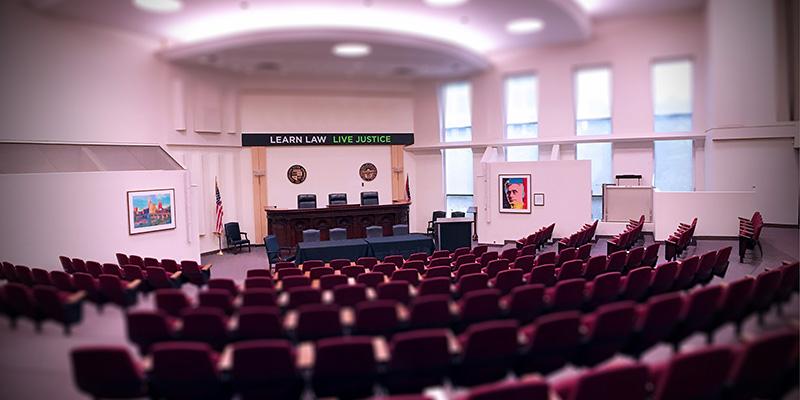
Moot Court Night 2026
The CSU Law Moot Court Team competes in simulated appelllate advocacy competitions where students argue hypothetical legal cases against other schools before a panel of judges. Members engage in extensive legal research, draft persusaive appellate briefs, and deliver oral arguments responding to challneging questions. The competition format mirrors real-world appellate proceedings, with each competition focusing on a specific area of the law. Moot Court helps students refine their legal reasoning, public speaking, and advocacy skills while providing valuable experience in high-pressure legal enviorments. Team members compete in regional and national competitions, gaining recognition for their school and netwokring with other legal professionals.
Watch Recording (opens in new window)
Moot Court Executive Board
- Chairperson - Serena Sammarone, 3L
- Vice Chairperson - Anna Egensperger, 3L
- Vice Chairperson - Annalise Nunes, 3L
The Problem
Petitioner Willow Schimmel alleges that she was falsely imprisoned by a Transportation Security Officer (TSO) while passing through a TSA security checkpoint at the fictional Eastland International Airport. While waiting in a slow-moving line, Schimmel recorded herself and TSA activity on her smartphone, criticizing the screening process. A TSO instructed her to stop recording, asserting that filming interfered with TSA operations and implicated security concerns. When Schimmel refused, the TSO blocked her from proceeding through the checkpoint for approximately four minutes until she stopped recording. She was then permitted to proceed but missed her flight and alleges physical injury and emotional distress.
Schimmel sued the United States under the Federal Tort Claims Act (FTCA), asserting false imprisonment under state law. The case is now in front of the United States Supreme Court. The issues on appeal are 1) Whether Transportation Security Administration screeners are “investigative or law enforcement officers” within 28 U.S.C. § 2680(h)’s law enforcement proviso, such that the United States’ sovereign immunity is waived for the intentional tort of false imprisonment and 2) Whether the discretionary function exception, 28 U.S.C. § 2680(a), bars a tort action notwithstanding a plausible allegation that a government employee’s conduct violated the Constitution.
The Counselors
For Petitoners
- Joshua Digman, 2L
- Jordan Taylor, 2L
For Respondent
- Anna Egensperger, 3L
- Anna Nunes, 3L
- Cal Ruebensaal, 3L